Zen Temples in Kyoto: Eight Temples, Their Hours and Fees, and Which Ones You Can Sit In
Kyoto's Zen temples compared: Tenryu-ji, Ryoan-ji, Nanzen-ji, Kodai-ji, Tofuku-ji, Daitoku-ji, Myoshin-ji and Kennin-ji, with hours, entry fees and where visitors can sit zazen.
Kyoto’s great Zen temples are mostly places to visit, not to sit in: you walk their gardens and halls on an entry ticket. Four of the eight below also offer zazen to the public. Tofuku-ji and Kennin-ji each hold a free early sitting on set Sundays, in Japanese; Myoshin-ji runs its own paid sittings in Japanese and is home to Jusho-in and Shunko-in, two sub-temples that teach zazen in English; and Kodai-ji takes group bookings. For a first sitting with English, Denei Japan tour’s two sittings with the abbot of Jusho-in are US$113 a person.
The Eight Temples at a Glance
| Temple | Area | Hours | Adult entry | Sit zazen? | |
|---|---|---|---|---|---|
| Myoshin-ji | North-west | 9:00 AM to 4:00 PM | JPY 500 | Yes: its own sittings in Japanese; Jusho-in and Shunko-in in English | See the Jusho-in sittings |
| Tofuku-ji | South-east | 9:00 AM to 4:00 PM; to 3:30 PM from 7 December | JPY 600 for the Hojo garden | Yes: free on listed Sundays; a guided morning with lunch | See the Tofuku-ji morning |
| Kennin-ji | Gion | 10:00 AM to 4:30 PM, last entry | JPY 800; JPY 1,000 from 1 January 2027 | Yes: free on the second Sunday of the month | See the guided visit |
| Kodai-ji | Higashiyama | 9:00 AM to 5:00 PM, last entry | JPY 800 | Groups of seven or more, by fax, in Japanese | Zazen near Kodai-ji |
| Ryoan-ji | North-west | 8:00 AM to 5:00 PM; 8:30 AM to 4:30 PM, December to February | JPY 600 | No public sitting on its own site | Sit at Myoshin-ji nearby |
| Tenryu-ji | Arashiyama | 8:30 AM to 5:00 PM | JPY 500 for the garden | No public sitting on its own site | Zazen with a monk instead |
| Nanzen-ji | East, below the Higashiyama hills | 8:40 AM to 5:00 PM; to 4:30 PM, December to February | JPY 600 for the Hojo garden; JPY 600 for the Sanmon | No public sitting on its own site | Zazen in Higashiyama |
| Daitoku-ji | North | Set by each sub-temple | Set by each sub-temple | No public sitting listed | Sit at Myoshin-ji instead |
Hours and fees are each temple’s own, as its site gives them; Daitoku-ji’s are from Kyoto City’s travel guide, kyoto.travel. Session prices are one adult’s regular price on GetYourGuide.
Myoshin-ji: Where Most Visitors Sit
Myoshin-ji, in Hanazono in north-west Kyoto, is the head temple of the Myoshinji branch of Rinzai Zen, founded in 1342 on the former palace of Emperor Hanazono. It is a walled precinct of sub-temples crossed by a public road, so the grounds never close; the paid area is the Dharma Hall with its cloud-dragon ceiling and the bell dated 698, open 9:00 AM to 4:00 PM (tickets until 3:30 PM) for JPY 500. JR Hanazono station is five minutes’ walk from the South Gate, by the temple’s own access page.
Four ways to sit here:
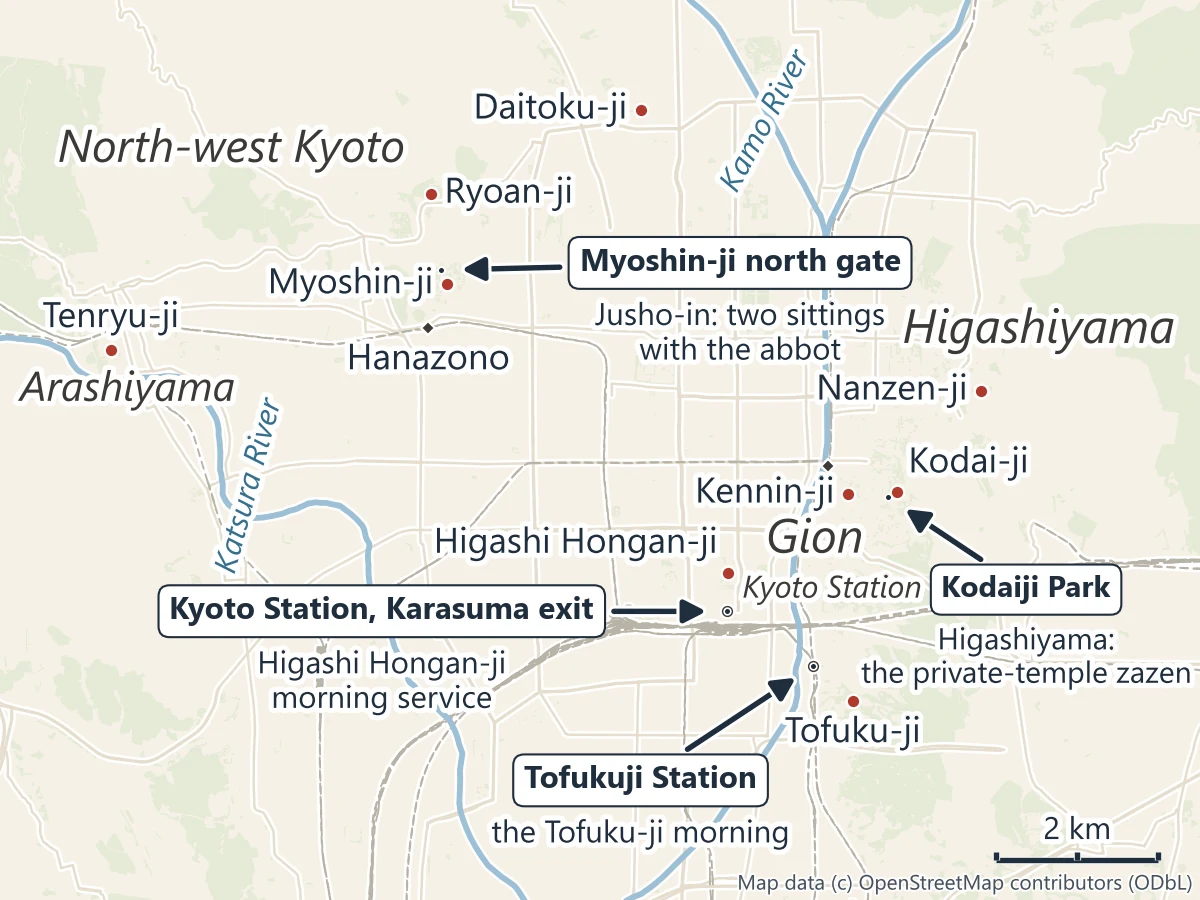
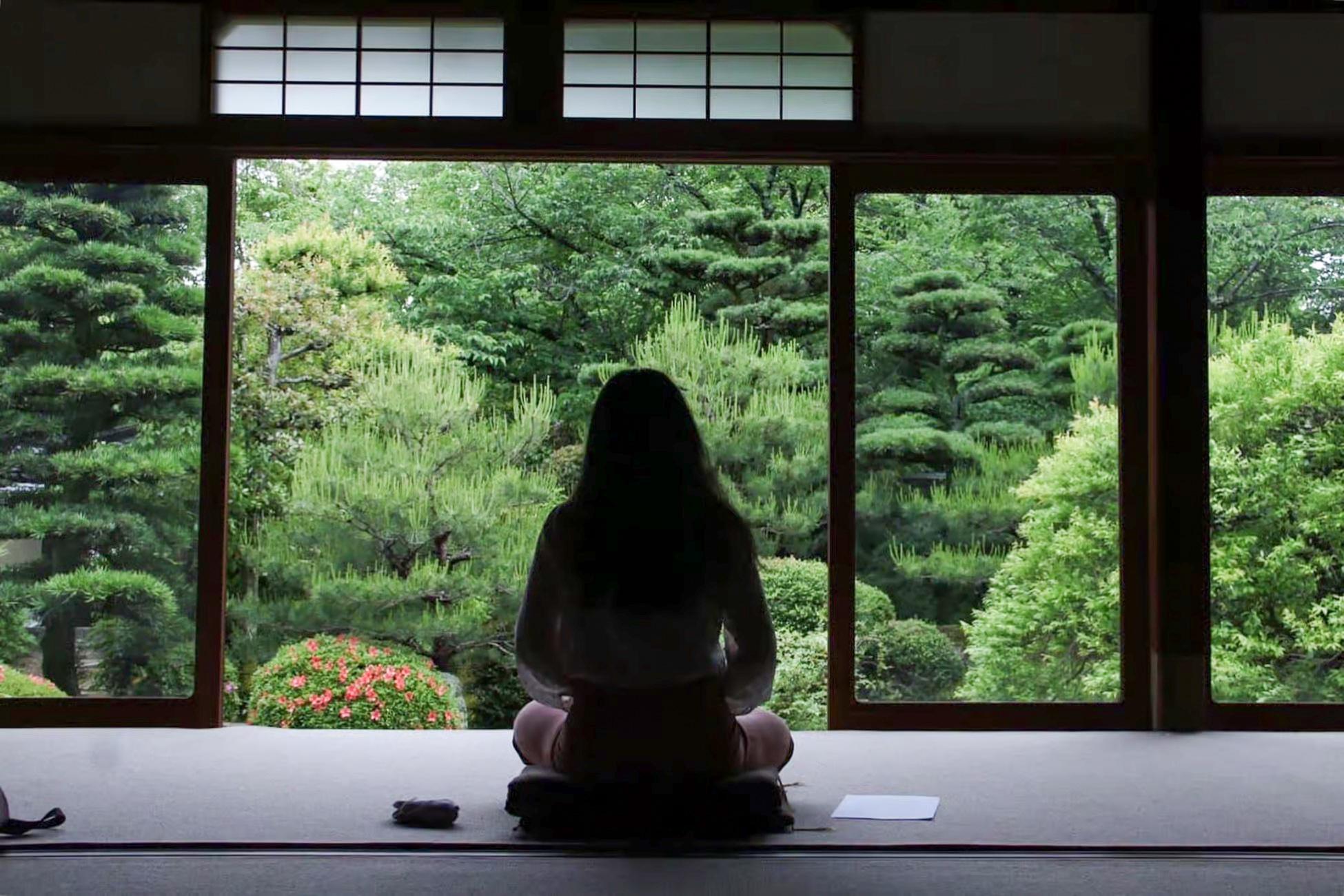
- Jusho-in, with Denei Japan tour. The sub-temple, founded in 1599 and normally closed, opens for two zazen sittings led by its sixteenth abbot, then matcha and seasonal sweets; an English-speaking guide interprets and chairs are set out for anyone who needs one. About two hours from the north gate, US$113.
- Shunko-in, booked direct. This sub-temple, founded in 1590, runs its Kissako zen and tea experience in English: about two hours of two meditation periods with tea, a dharma talk and a tour of the garden and hall, for up to 12 people. It sells it only through the ticket pages linked from its own schedule, at JPY 24,200 a person including tax for the English session, and charges the full fee for a cancellation made fewer than seven days ahead.
- Myoshin-ji’s own sittings. The Daishu Zendo holds public zazen sessions on Saturday and weekday afternoons and Wednesday evenings, in Japanese only, for 20 people, with online registration that closes five days ahead: JPY 2,000 the first time and JPY 1,000 after. None run in January or August.
- Zen and yoga, with SUNNY YOU Yoga Studio. Two hours in a normally closed part of Myoshin-ji: a Zen talk, yoga facing the garden and tea, US$119. It is yoga, not a zazen sitting.
Check dates for the Jusho-in sittings
Tofuku-ji: a Free Sunday Sitting and a Guided Morning
Tofuku-ji, in Higashiyama-ku in the south-east, is the head temple of the Tofukuji branch of Rinzai Zen, built between 1236 and 1255 with Enni as its first priest, and one of Kyoto’s five Gozan temples. It opens 9:00 AM to 4:00 PM from April to 6 December (Tsutenkyo from 8:30 AM in the autumn weeks, 14 November to 6 December) and 9:00 AM to 3:30 PM from 7 December to March. Entry is JPY 600 for the Hojo garden and JPY 600 for Tsutenkyo and the Kaisando, JPY 1,000 for that area in the autumn weeks; the JPY 1,000 combined ticket is not sold in the autumn weeks.
Its Sunday zazen runs 6:30 to 7:00 AM on the dates the temple lists, free, first come, first served, followed by a dharma talk of 40 to 50 minutes; the temple asks for loose clothing and says the leader may use the keisaku. Free zazen in Kyoto has the dates. MagicalTrip's morning is the guided version: Komyo-in’s garden, Tofuku-ji, an hour of zazen at Shorin-ji and a shojin lunch, US$107. Tofuku-ji in full.
Kennin-ji: Kyoto’s Oldest Zen Temple
Kennin-ji, beside Gion, was founded in 1202 with Eisai as its first abbot and calls itself the oldest Zen temple in Kyoto; it is the head temple of the Kenninji branch of Rinzai Zen and the third of the city’s Gozan. Visitors come for the twin dragons painted on the ceiling of the Dharma Hall and the Fujin and Raijin screens. It opens 10:00 AM, with last entry at 4:30 PM, for JPY 800, rising to JPY 1,000 from 1 January 2027. Keihan Gion-Shijo is seven minutes’ walk.
Its Senkokai zazen is free and needs no booking: the second Sunday of each month at 7:30 AM, about two hours of two 20-minute sittings, chanting and a talk, with none in August; the next on its page is Sunday 13 December 2026, in the Hojo. On 13 December 2026 the temple has cancelled the talk. Groups of ten or more are asked not to join it. DeepExperience's 90-minute guided visit, US$47, explains the gardens and the dragons but includes no zazen.
Kodai-ji
Kodai-ji, on the slope of Higashiyama, was founded in 1606 by Nene, the widow of Toyotomi Hideyoshi, in his memory; it belongs to the Kenninji branch of Rinzai Zen, and its mausoleum is known for Kodaiji maki-e lacquer. It opens 9:00 AM to 5:00 PM (last entry), JPY 800 for an adult, with night openings in the autumn. Its zazen is for groups only, booked by fax at least a week ahead, in Japanese: JPY 1,500 an adult with temple entry, for seven people or more. Kodaiji Park, beside the temple, is where Travel Japan Together's private-temple session meets; that temple is a different one, closed to the general public.
Ryoan-ji
Ryoan-ji, in north-west Kyoto, began in 1450 when Hosokawa Katsumoto invited Giten Gensho, then abbot of Myoshin-ji, to turn his villa into a temple; its dry stone garden in front of the Hojo is the reason most people come. It opens 8:00 AM to 5:00 PM from March to November and 8:30 AM to 4:30 PM from December to February, JPY 600 for an adult. Its own site lists no public zazen; Myoshin-ji’s sub-temples, a short bus or train ride away, are the nearest place to sit.
Tenryu-ji
Tenryu-ji, in Arashiyama, is a Rinzai Zen temple complex founded in 1339, a UNESCO World Heritage site known for the Sogen Pond garden and the cloud dragon in its Dharma Hall. It opens 8:30 AM to 5:00 PM (last entry 4:50 PM); the garden is JPY 500 for an adult, the buildings JPY 300 more, and the cloud dragon a separate JPY 500 ticket. Its own visitor pages list no zazen session.
Nanzen-ji
Nanzen-ji, at the foot of the Higashiyama hills, is the head temple of the Nanzenji branch of Rinzai Zen, founded in 1291 by Emperor Kameyama; its Sanmon gate was rebuilt in 1628. It opens 8:40 AM to 5:00 PM from March to November and to 4:30 PM from December to February, and is closed to general visitors from 28 to 31 December; the Hojo garden and the Sanmon are JPY 600 each and Nanzen-in JPY 500. Keage subway station is ten minutes’ walk. Its own site lists sutra copying and talks but no zazen.
Daitoku-ji
Daitoku-ji, in Murasakino in the north of the city, was founded in 1315 and is a working Zen centre of many sub-temples, a few of which open their gardens and tea rooms to visitors, Daisen-in among them. Each sub-temple sets its own hours and fee. No public zazen is listed for it.
Two Zazen Sittings with the Abbot of Jusho-in, Myoshin-ji, with Matcha
Two zazen sittings with the abbot of Jusho-in, matcha and seasonal sweets, an English-speaking guide; about two hours from the north gate.
Check dates for Jusho-in →Zen Meditation with a Monk at a Private Temple in Higashiyama
Travel Japan Together's ninety minutes from Kodaiji Park: the monk's lesson, the sitting, then tea and questions.
See the private-temple session →Prices are one adult’s regular price for the option named, in US dollars on GetYourGuide and in yen on Viator; ratings and review counts are each listing’s own. They are a guide, not a quote: the price for your date shows before you pay.
FAQ
Which Zen temple in Kyoto lets you do zazen?
Tofuku-ji and Kennin-ji hold free early sittings on set Sundays, in Japanese; Myoshin-ji runs paid sittings in Japanese; and two of its sub-temples teach in English, Jusho-in through Denei Japan tour and Shunko-in by direct booking. Ryoan-ji, Tenryu-ji, Nanzen-ji and Daitoku-ji list no public zazen.
Can you meditate at Ryoan-ji?
Not in a session: Ryoan-ji’s own site lists no zazen for visitors. The nearest sittings are at Myoshin-ji, a short ride away.
What is the oldest Zen temple in Kyoto?
Kennin-ji, founded in 1202 with Eisai as its first abbot, as the temple itself says.
Two Sittings with an Abbot at Myoshin-ji
Denei Japan tour's two hours at Jusho-in, a Myoshin-ji sub-temple founded in 1599: the abbot's introduction to Zen, two zazen sittings, then matcha and seasonal sweets.
Check dates for Jusho-in